



Chicken production is highly sensitive to feed efficiency. Feed represents a major operating expense, and small improvements in handling, formulation consistency, and feed utilization can have a meaningful effect on overall farm performance.
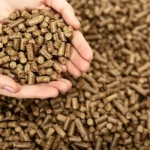
Pelletized feed is widely used because it offers practical advantages over loose feed. It is easier to transport, store, and handle, while the granulation process can help create a more uniform product.
However, producing poultry pellets successfully requires careful planning.
A chicken feed production line should be designed around the bird type, feed formula, target capacity, pellet specification, and operating conditions.
Different Chickens, Different Feed Requirements
“Chicken feed” is a broad term.
Broilers, layers, breeders, and young chicks may require different formulations.
Broiler production often involves starter, grower, and finisher feeds. Layer feed, meanwhile, has different nutritional priorities because laying birds require appropriate calcium and other nutrients.
This means that a feed plant serving several production stages may need flexibility.
A producer should define which formulations will be produced before selecting the pelletizing system.
What Is the Role of a Feed Granulator?
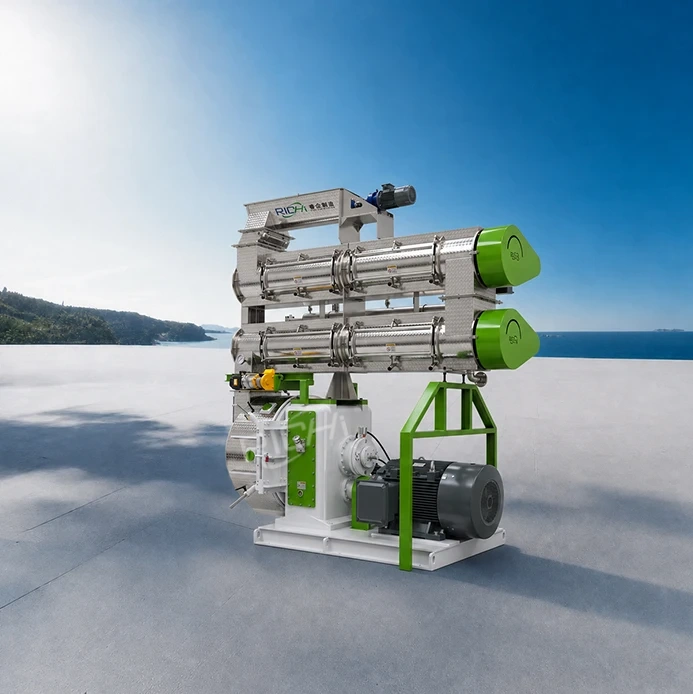
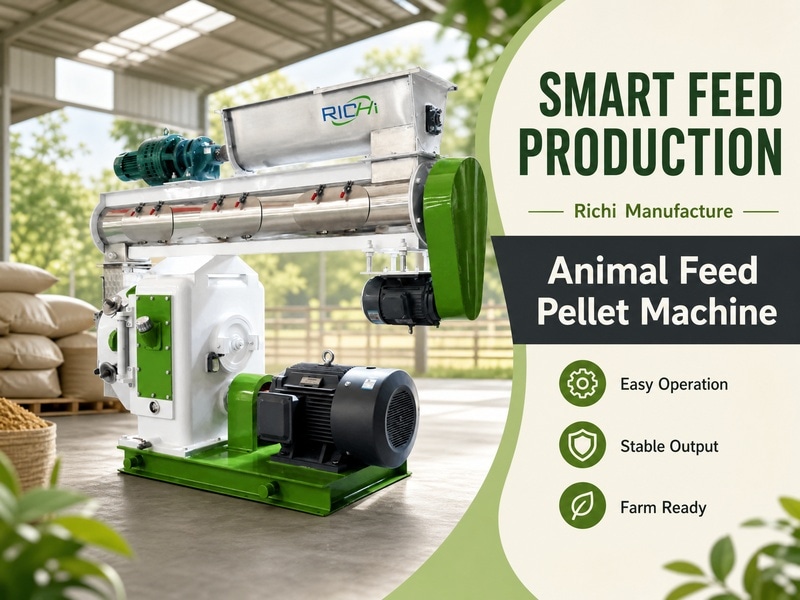
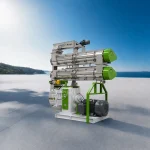
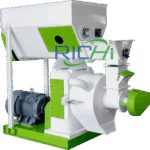
A Feed Granulator Machine compresses prepared feed material into pellets.
But pelletizing is only one stage in the process.
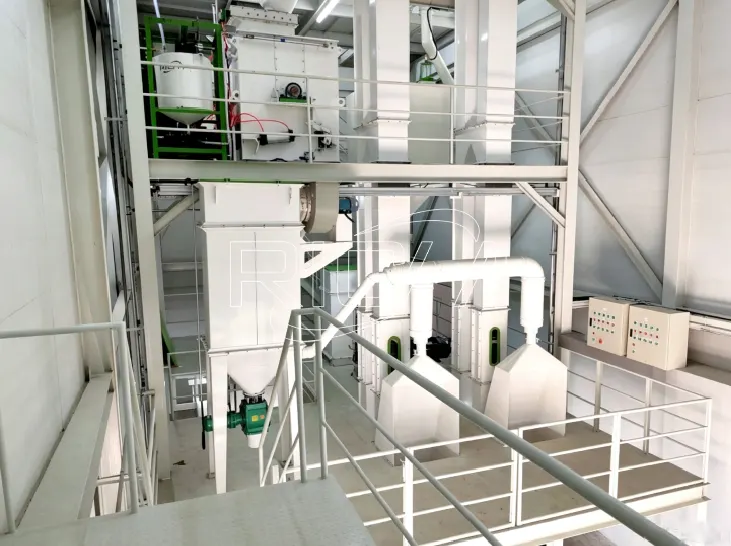
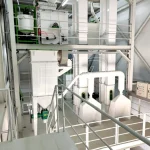
A typical poultry feed plant may include:
- Raw material cleaning
- Grinding
- Ingredient batching
- Mixing
- Conditioning
- Pelletizing
- Cooling
- Crumbling when required
- Screening
- Packing
The exact configuration depends on the target product.
For example, young chicks may require crumbled feed rather than conventional full-size pellets.
Why Particle Size Matters
Particle size influences both feed processing and animal consumption.
Grinding reduces the size of grains and other ingredients so they can be mixed more uniformly.
If particles are too large, the mixture may be inconsistent and pellet formation can become more difficult.
If particles are excessively fine, energy consumption can increase and the material may behave differently during conditioning and pelletizing.
Therefore, particle size should be selected based on the formulation and final feed specification.
Choosing Capacity for a Poultry Farm
Capacity planning should begin with actual feed consumption.
Consider a farm producing 10,000 broilers. The required feed volume will change as the birds grow.
A larger commercial operation may need continuous feed production, while a smaller farm may produce feed only periodically.
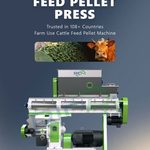
A buyer considering a 5-6 T/H chicken feed pellet machine for sale should evaluate whether 5-6 tons per hour reflects real demand or merely represents an attractive machine specification.
If the machine will operate only a few hours per week, the investment may not be efficiently utilized.
If the farm is expanding rapidly, however, additional capacity may be justified.
What Happens Before Pelletizing?
Pelletizing performance is heavily influenced by preparation.
Raw materials may arrive in different forms and sizes.
Corn may need grinding. Soybean meal may already have a suitable particle size. Bran may require screening. Mineral additives may be added in small quantities.
The plant must bring these materials together in a controlled way.
Batching accuracy is particularly important because poultry diets can contain multiple ingredients in relatively precise proportions.
Mixing: The Hidden Foundation of Feed Quality
Pellets are only as uniform as the mixture from which they are made.
Suppose a feed formula contains corn, soybean meal, wheat bran, vitamins, minerals, and other additives.
If the mixer does not distribute these ingredients properly, the pellets may vary nutritionally.
A reliable mixer should create a consistent blend within an appropriate processing time.
This becomes increasingly important when production volumes increase.
(Related Post: https://www.richipelletmill.com/chicken-feed-pellet-making-machine/)
Conditioning and Pellet Quality
Conditioning can influence pellet formation, durability, and energy consumption.
Steam conditioning is widely used in commercial feed processing, although the exact requirements depend on the formulation and equipment.
Moisture and temperature need to be controlled carefully.
Too little conditioning may result in weak pellets or unstable production. Excessive moisture can increase cooling and drying demands.
The ideal conditions depend on the raw materials and final feed specification.
Why Pellet Durability Matters to Poultry Producers
Poultry feed may travel through conveyors, elevators, storage bins, trucks, and feeders before reaching the animals.
Every handling stage can generate fines.
Excessive fines can reduce product quality and create dust.
Therefore, durability should be considered throughout the production process.
Grinding, formulation, conditioning, die compression, cooling, and screening can all influence the final result.
Cooling Protects the Finished Feed
Pellets leave the pellet mill at elevated temperatures.
They need to be cooled before packaging.
A properly designed cooler reduces temperature and helps stabilize moisture.
This is particularly important when feed will be stored for extended periods.
Packaging warm pellets can create condensation inside bags, which can negatively affect storage quality.
Therefore, cooling should not be treated as an optional accessory in a commercial poultry feed plant.
When Is Crumbling Necessary?
Chicks may not be able to consume standard-size pellets comfortably.
For starter feed, producers may use crumbled pellets or smaller particles.
A crumbler can break larger pellets into relatively uniform pieces.
The advantage of producing pellets first and then crumbling them is that the feed ingredients have already been compacted into a stable form.
This can improve handling compared with producing a completely loose mixture.
Storage Is Part of Feed Production
Feed quality does not end at the production line.
Storage conditions can affect the final product significantly.
Moisture, temperature, pests, and handling conditions all need to be controlled.
A well-designed storage area should protect feed from moisture and contamination.
Bulk storage may be suitable for large operations, while bagged feed may be more convenient for smaller farms.
The packaging format should therefore be considered when designing the production line.
How Much Automation Is Appropriate?
Automation can improve consistency and reduce manual labor.
Automated systems may control ingredient weighing, batching, mixing, material transfer, and production monitoring.
For a large commercial feed mill, automation can become highly valuable because many tons of material are processed every day.
For a smaller farm, a semi-automatic system may provide a better balance between cost and convenience.
The objective should not be to maximize automation.
The objective should be to automate the tasks where consistency, labor savings, and operational control justify the investment.
What About Energy Costs?
Feed production consumes energy at several points.
Grinding requires power. Pelletizing requires mechanical energy. Conveyors, elevators, cooling systems, and packaging equipment also consume electricity.
The actual energy requirement depends on raw materials, capacity, moisture, and equipment design.
Producers should therefore evaluate the complete system rather than comparing motor ratings alone.
Energy efficiency can become especially important when electricity prices are high or production runs continuously.
Choosing a Supplier
Equipment suppliers can differ significantly in technical support and engineering capability.
A producer should look beyond machine photographs.
Useful questions include:
- Can the supplier design the complete process?
- Can they recommend suitable equipment for the feed formula?
- Are spare parts available?
- Is installation support provided?
- Can operators receive training?
- Are similar projects available for reference?
- Can the supplier provide a process flow diagram?
- What maintenance is required?
A company with experience in complete feed processing may be more useful than a supplier that only sells individual machines.
For producers comparing different systems, Richi Machinery can be one of the sources to examine when researching feed processing equipment and plant configurations.
Is a Larger Pellet Mill Always Better?
Not necessarily.
A larger pellet mill may provide higher theoretical capacity, but if the rest of the production line cannot support that output, the additional capacity may remain unused.
For example, if the grinder can prepare only three tons of material per hour, installing a pellet mill designed for six tons per hour does not automatically create six-ton production.
The entire production chain should therefore be balanced.
Planning for Future Growth
Poultry businesses can grow quickly.
A farm may begin with one production house and add additional houses later.
A feed plant designed with expansion in mind can make this transition easier.
However, future capacity should be realistic.
It is usually more economical to install equipment that meets current demand while leaving reasonable room for additional storage, conveyors, packaging capacity, or another processing line.
A Practical Way to Compare Equipment
Instead of asking “Which machine is the best?”, buyers can ask:
Which system is the best match for my production conditions?
Compare equipment according to:
| Factor | Key Question |
|---|---|
| Capacity | Does it match actual feed demand? |
| Formula | Can it handle the planned ingredients? |
| Pellet size | Can the required size be produced? |
| Power | Is the electrical supply suitable? |
| Automation | How much labor is available? |
| Maintenance | Can wear parts be sourced easily? |
| Layout | Does it fit the available building? |
| Expansion | Can production be increased later? |
This approach is more useful than comparing machines by price alone.
Where Can Poultry Producers Continue Their Research?
Feed manufacturing involves many variables, so it is useful to compare multiple technical sources.
Agricultural publications, feed industry references, equipment manufacturers, and online technical materials can all provide useful information.
When evaluating specific machinery, producers can find out here now about different processing configurations and then discuss the actual feed formula with an experienced equipment supplier.
The final equipment selection should always be based on the specific project.
Conclusion
Chicken feed pellet production is a system rather than a single machine.
The quality of the final product depends on the relationship between raw material preparation, grinding, batching, mixing, conditioning, pelletizing, cooling, screening, and packaging.
Capacity should be selected according to actual feed demand, while pellet size should reflect the target bird and feeding program.
For smaller farms, simplicity and flexibility may be priorities. For large poultry operations, throughput, automation, durability, and operating costs become increasingly important.
The best feed granulation system is therefore not necessarily the largest or most advanced option. It is the one that creates a reliable connection between the farm’s nutritional objectives and its production capabilities.