Many mixed farms raise more than one type of animal. A producer may keep chickens, pigs, cattle, sheep, or goats while using agricultural ingredients from the same farm. Producing feed independently can provide greater control over raw material use, but the equipment must be flexible enough to handle different formulas.
A small animal feed pellet machine can be a practical solution when feed demand is moderate and the producer does not require an industrial-scale factory.
One Farm, Several Feed Formulas
Different animals have different nutritional requirements. Poultry feed may rely heavily on grain and soybean meal, while cattle and sheep formulas can contain more forage or fibrous ingredients.
A flexible production system can help farmers process several formulas using the same basic pelleting equipment.
However, changing formulas requires proper cleaning and production planning. Ingredients from the previous batch should not unnecessarily remain in the equipment when the next formula is introduced.
Choosing the Right Capacity
Small-scale equipment should be selected according to actual feed consumption.
If the farm consumes a limited amount of feed each day, a large commercial machine may remain underutilized. A smaller machine can allow the farmer to produce feed according to actual demand without excessive capital investment.
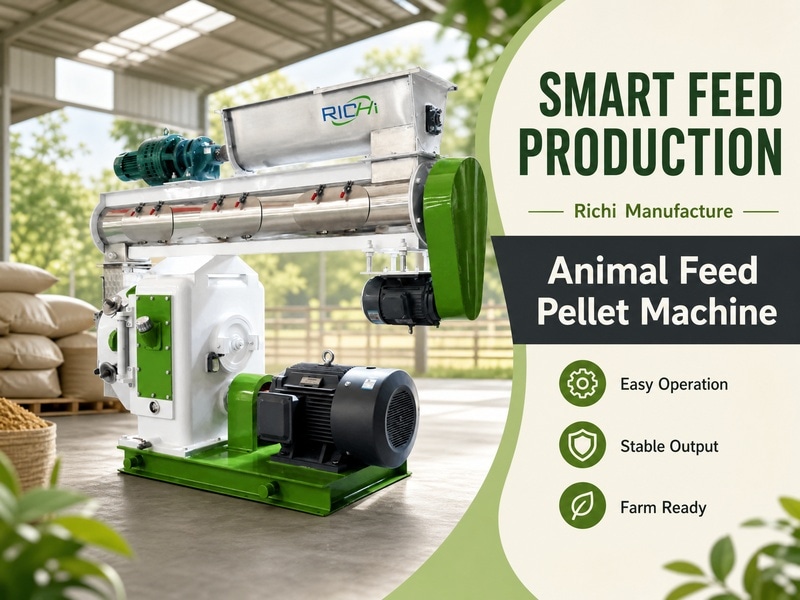
A poultry and livestock feed pellet mill can be useful when the same facility needs to produce several feed types, provided that the formulas and pellet sizes are compatible with the selected equipment.
Preparing Different Raw Materials
Raw materials should be prepared according to their physical characteristics. Grain ingredients generally require grinding before mixing, while forage may require additional size reduction depending on the formula.
The mixer then combines the ingredients uniformly. Consistent mixing becomes especially important when several feed formulas are produced in the same facility.
Farmers should also consider how raw materials are stored because moisture or contamination can affect feed quality before the ingredients even reach the pellet mill.
Managing Pellet Sizes
Different animals may require different pellet dimensions. Young poultry may consume smaller particles, while some livestock applications can use larger pellets.
Changing pellet size normally involves selecting an appropriate die. Farmers who produce several sizes should consider the time required for die changes and cleaning.
The production schedule can be organized to reduce unnecessary changeovers.
Keeping the Process Simple
A small farm does not necessarily need a highly automated factory. A practical system might include a grinder, mixer, pellet mill, cooler, and basic packing arrangement.
The key is to ensure that the machines are correctly matched. An oversized grinder combined with a very small pellet mill does not necessarily improve the overall process.
Similarly, if finished pellets are not cooled properly before storage, product quality may be affected.
Maintenance on the Farm
Small farms often rely on a limited number of operators. Equipment should therefore be easy to inspect and maintain.
Operators should regularly check lubrication points, rollers, dies, bearings, belts, and electrical components. Cleaning is also important when several formulas are produced.
Unusual vibration or changes in pellet appearance can provide early warning of mechanical or process problems.
Farm operators can use next information resources to compare different feed equipment configurations before selecting a system.
Planning for Expansion
A farm may grow over time. More animals can mean greater feed demand, while commercial feed sales may eventually become an additional business.
It can therefore be useful to leave room for future expansion without purchasing an unnecessarily large machine at the beginning.
Richi Pelletizer equipment can be configured for different animal feed applications according to production requirements and raw material characteristics.
A Practical Approach to Farm Feed Production
The most suitable small feed system is one that fits the farm rather than one that simply offers the highest specification.
Farmers should consider animal types, daily feed demand, available ingredients, desired pellet sizes, working hours, labor, and future growth.
With suitable raw material preparation, consistent mixing, controlled feeding, effective pelleting, and proper cooling, a compact feed system can provide a practical way for mixed farms to manufacture their own feed while maintaining greater control over production.
view details: https://www.richimanufacture.com/animal-feed-pellet-machine-for-sale/