


alk into a rabbit barn at feeding time and watch the floor. In many operations, a noticeable share of the feed never reaches the rabbit. It ends up as powder under the cage, fines in the feeder tray, or crumbs the rabbit pushes aside with its nose. The farmer pays for that feed. The rabbit does not eat it.
This is not a small leak. Feed is the largest recurring cost in most rabbit operations. When a meaningful fraction of it is wasted, the loss compounds across every animal, every cycle, and every season. Farmers often respond by switching feed brands, adjusting rations, or blaming the rabbit. But the root cause is frequently simpler and more physical: the pellet itself.
Pellet quality is not a cosmetic issue. It determines how much feed the rabbit consumes, how efficiently it converts, and how much ends up as waste. Understanding what drives pellet quality—and where the pellet comes from—is more useful than comparing machine specifications. For farms that are already producing their own feed or considering it, the choice of a rabbit pellet making machine sits at the center of that discussion, but it is not the starting point. The starting point is the feed itself.
Why Rabbits Waste Feed
Rabbits are selective eaters. Given a mixture of pellets, fines, and dust, they will pick out the pellets and leave the rest. That behavior is not stubbornness. It is a natural feeding instinct shaped by the rabbit’s anatomy and digestive system.
A rabbit’s mouth is small. Its teeth are designed for gnawing and grinding fibrous material. It prefers feed that offers resistance—something it can bite, hold, and chew. Fine powder offers none of that. It sticks to the tongue, clogs the mouth, and is difficult to swallow. So the rabbit ignores it.
The result is a two-part loss. First, the rabbit does not consume the fines, so the farmer pays for feed that is never eaten. Second, the fines that remain in the feeder can absorb moisture, clump, and spoil, which may discourage the rabbit from eating at all.
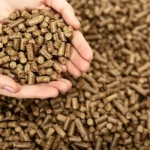
The solution is not to force the rabbit to eat powder. The solution is to produce a pellet that holds together, resists breakage, and presents a consistent physical form from the first bite to the last.
What Pellet Quality Actually Means in Rabbit Farming
Pellet quality is often reduced to a single number: durability. That is a useful metric, but it is not the whole story. For rabbits, several characteristics interact to determine how much feed is consumed and how well it is digested.
Durability describes how well a pellet survives handling, transport, and feeding without breaking apart. A durable pellet does not crumble into fines before the rabbit reaches it. Durability is measured by tumbling a sample and calculating the percentage of intact pellets. High durability means less waste.
Hardness is related to durability but distinct. A pellet can be durable but too hard for a rabbit to chew comfortably. Rabbits prefer a pellet that offers some resistance but breaks down readily under pressure. A pellet that is too hard may be dropped or ignored. A pellet that is too soft crumbles before it is eaten.
Size and uniformity affect how easily the rabbit picks up the pellet and how consistently it consumes feed. Uniform pellets reduce selective feeding. Mixed sizes encourage the rabbit to pick and choose, which increases waste.
Moisture content affects storage stability and palatability. Pellets that are too dry are brittle and generate fines. Pellets that are too wet can mold during storage, which is a health risk. The target moisture range for finished feed pellets is typically below 12–14%, depending on climate and packaging.
Nutrient consistency matters because a rabbit’s digestive system is sensitive to abrupt changes in feed composition. If pellet quality varies from batch to batch, the rabbit’s intake may vary too, which affects growth, reproduction, and health.
These characteristics are not independent. They are linked to the formulation, the preprocessing steps, and the equipment used to form the pellet. That is why pellet quality problems rarely have a single fix.
The Process Behind the Pellet
Understanding where pellets come from helps explain why quality problems occur. A pellet is not simply compressed powder. It is the result of a sequence of steps, each of which affects the final product.
Formulation and Ingredient Selection
Rabbit feed formulations typically combine energy sources (grains), protein sources (oilseed meals), fiber sources (hay, bran, agricultural byproducts), and mineral or vitamin premixes. Each ingredient has different physical properties—particle size, density, moisture, and binding behavior—that affect how the mixture pellets.
Fibrous ingredients, such as alfalfa meal or beet pulp, can improve pellet binding because their fibers interlock under pressure. But excessive fiber can also make the pellet brittle if the formulation is not balanced. Protein meals tend to be dense and flow well. Fine mineral particles can cause die wear if not properly dispersed.
The formulation sets the upper limit of pellet quality. No machine can make a good pellet from a poorly balanced mix.
Grinding and Particle Size
Ingredients arrive in different forms. Some are coarse, some are fine, and some are uneven. A hammer mill or similar grinder reduces the material to a consistent particle size before mixing.
Particle size affects pellet formation in two ways. Larger particles create weak points where the pellet can fracture. Very fine particles can clog the die and reduce throughput. The target is a narrow particle size distribution with minimal oversized material.
Research on rabbit feed processing has shown that grinding and formulation interact with extrusion conditions to influence pellet quality and nutrient digestibility. A study on growing meat rabbits found that optimal extrusion parameters were a barrel temperature of 125°C, material moisture of 16%, and a specific feed rate. That level of precision is not achievable by guesswork. It reflects the sensitivity of rabbit feed to processing conditions.
Mixing and Homogeneity
A rabbit eats many pellets per day. Each pellet should deliver approximately the same nutrient profile. That requires a homogeneous mix before pelletizing.
Mixers vary in their ability to handle different formulations. Light, fibrous ingredients tend to float, while dense minerals sink. A mixer that works well with one formulation may struggle with another. The goal is a uniform blend that feeds into the pellet mill at a consistent rate and composition.
Moisture and Conditioning
Moisture is the most common cause of pellet quality problems. Inadequate moisture prevents proper binding. Excess moisture causes the material to slip through the die without forming a dense pellet, and it can lead to mold during storage.
Conditioning—adding steam or water to the mix before pelletizing—improves binding and reduces die wear. But conditioning must be controlled. Excess moisture can make rollers slip and reduce yield, as noted in feed milling literature. The optimal moisture level depends on the formulation, the die, and the ambient conditions.
Pelletizing and Cooling
The pellet mill forms the pellet by forcing material through a die. The die’s thickness, hole diameter, and compression ratio determine the density and hardness of the finished pellet. After extrusion, the pellets are hot and moist. They must be cooled gradually to prevent cracking and to bring moisture down to a safe storage level.
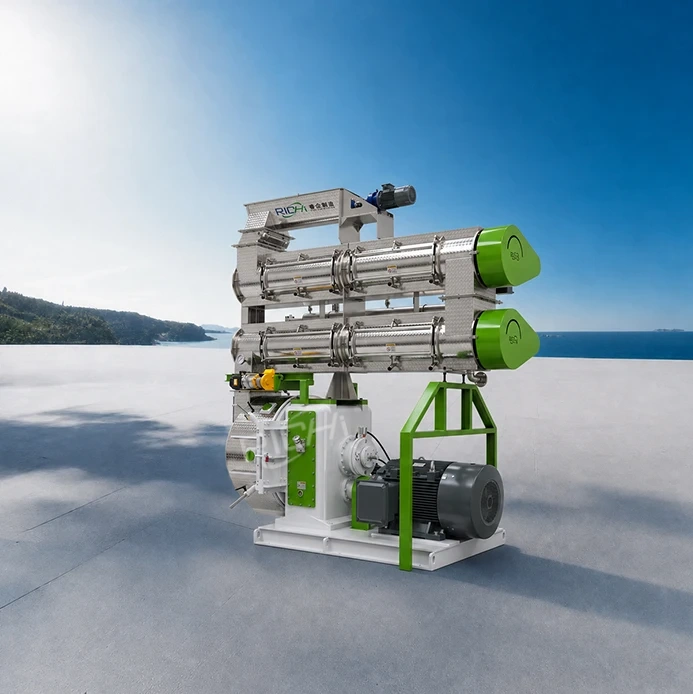
Cooling is often overlooked in small operations, but it directly affects durability. Pellets that are cooled too quickly become brittle. Pellets that are not cooled enough remain soft and prone to mold.
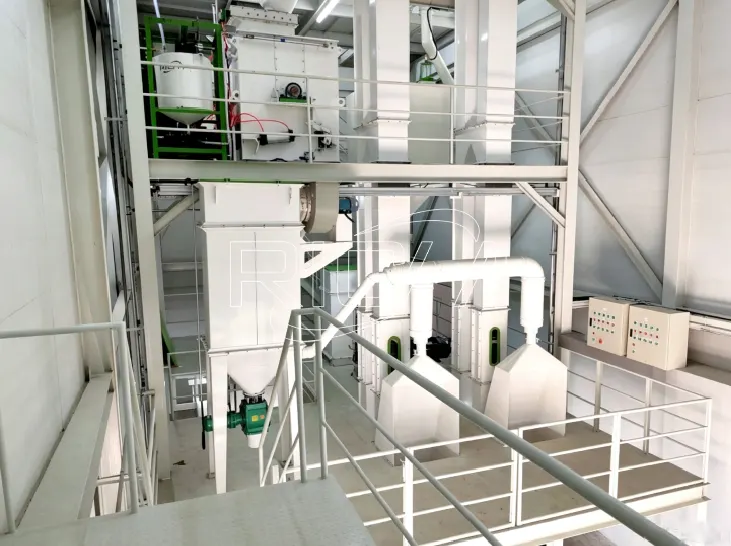
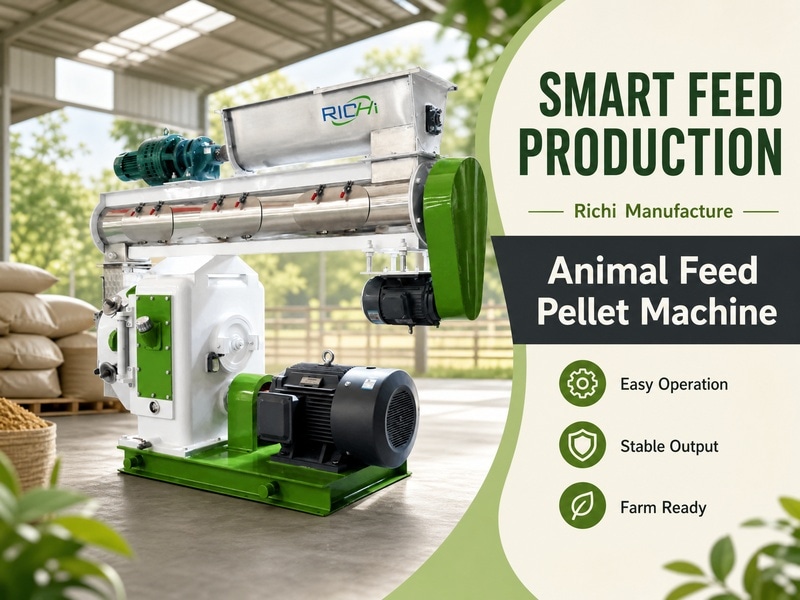
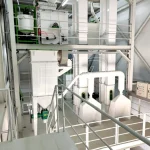
For farms that are new to feed processing, it helps to understand how a feed pellet machine fits into a complete production line. The pellet mill is the core, but it depends on grinding, mixing, and cooling equipment to produce a consistent finished pellet. Manufacturers who serve multiple species and production scales often provide practical guidance on how these components work together.
When On-Farm Pelletizing Makes Sense
The question of whether to produce pellets on the farm is not the same as the question of whether to buy a machine. It is a question about feed cost, control, and consistency.
On-farm pelletizing makes sense when several conditions are present. The farm consumes enough feed to justify the capital and operating cost of a pellet line. Ingredients are available locally at a cost that makes home production cheaper than purchasing finished pellets. The farm has the labor and technical capacity to manage the process consistently. And the rabbits benefit from a pellet that matches their nutritional requirements more closely than a generic commercial product.
It makes less sense when feed volumes are small, ingredient sourcing is unreliable, or the farm lacks the labor to manage grinding, mixing, moisture control, and cooling. In those cases, the cost and complexity of on-farm pelletizing may exceed the savings.
The decision is not about whether a machine is a good investment in the abstract. It is about whether the farm’s feed situation—volume, cost, ingredient access, and labor—makes the investment worthwhile. A farm that currently buys bagged feed at retail prices has a different starting point than a farm that already mixes its own mash.
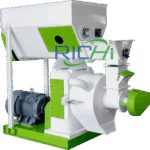
For operations that produce feed for multiple species or want to integrate pelletizing into a broader production system, it is worth understanding how different equipment options fit together. A rabbit feed pellet making machine for farm use is one component in a line that may include grinding, mixing, conveying, and cooling equipment. The configuration depends on the farm’s specific production flow, not on a standard package.
What Determines Whether the Investment Pays Off
Several factors determine whether on-farm pelletizing delivers a return.
Feed volume. The more feed the farm produces, the more the fixed costs of equipment and labor are spread across each tonne. Small operations may find that the cost per tonne of home-produced pellets is higher than purchased feed, even if the ingredients are cheaper.
Ingredient cost. The savings from on-farm pelletizing come primarily from replacing purchased finished feed with lower-cost raw ingredients. If the ingredients cost nearly as much as the finished feed, the processing cost becomes the deciding factor.
Utilization. A pellet line that runs at low capacity produces pellets at a higher cost per tonne because fixed costs are spread over fewer tonnes. Matching machine capacity to actual production volume is critical.
Labor. Pelletizing requires labor for grinding, mixing, monitoring, maintenance, and bagging or storage. If the farm does not have available labor, the process will be inconsistent, and inconsistent processing produces inconsistent pellets.
Pellet quality. The value of on-farm pelletizing depends on producing a pellet that the rabbits actually eat. A pellet that crumbles into fines creates the same waste problem the farm was trying to solve. Quality control is not optional.
Market or herd demand. If the farm is producing pellets for its own herd, the demand is fixed by the number of rabbits. If the farm is selling pellets, market demand and price become additional variables.
A realistic assessment of these factors before purchase is more valuable than a machine specification sheet. The equipment is necessary, but it is not sufficient. The system around the equipment determines the outcome.
Common Mistakes That Undermine Pellet Quality
Several recurring mistakes cause on-farm pellet operations to underperform.
Skipping or underestimating grinding. A pellet mill cannot compensate for inconsistent particle size. If the ingredients are not ground uniformly, the pellets will be inconsistent and prone to breakage.
Ignoring moisture variation. Ingredients stored in different conditions have different moisture levels. A formulation that pellets well one week may clog the die the next. Moisture monitoring and adjustment are not optional.
Cooling too quickly or not enough. Pellets that are cooled too fast become brittle. Pellets that are not cooled enough remain soft and may mold. Cooling is a controlled step, not a passive one.
Using a die that is worn or mismatched. Die condition and specification affect pellet density, hardness, and throughput. A worn die produces inconsistent pellets. A die that is too thick for the formulation may produce pellets that are too hard for rabbits to chew.
Assuming that any pellet is better than mash. A poorly made pellet is worse than a well-managed mash ration because it combines the cost of processing with the waste of fines. Pellet quality must be verified, not assumed.
For farms that want to see how a full feed production line is configured—including equipment for different species and production scales—it is worth spending time with a manufacturer that offers turnkey service. To understand how individual machines integrate into a complete system, you can browse around this site for more context.
A Practical Way to Think About the Decision
For a farm considering whether to produce its own rabbit feed pellets, the decision can be framed in a few practical steps.
First, measure the current feed waste. Collect the fines from feeders and floors for a week and estimate what percentage of purchased feed is not consumed. That number is the baseline the farm is trying to improve.
Second, define the target pellet. Determine the desired pellet diameter, durability, and moisture content based on the rabbit herd’s requirements and the feeding system.
Third, assess the ingredient supply. Identify the ingredients that will be used, their cost, and their availability throughout the year. Inconsistent ingredient supply leads to inconsistent pellets.
Fourth, evaluate the production system. Determine whether grinding, mixing, conditioning, pelletizing, and cooling can be managed consistently with available labor and technical support.
Fifth, calculate the full cost. Include capital, energy, labor, maintenance, and ingredient cost. Compare the cost per tonne with the cost of purchased feed and the value of reduced waste.
If those steps produce a clear picture, the equipment decision becomes straightforward. If they do not, the project is not ready for equipment procurement.
For a broader view of animal feed equipment options—including machines for different species and production capacities—this resource provides additional context: https://pelletmakermachine.com/animal-feed-machine/.
The Bottom Line
Feed waste in rabbit farming is not inevitable. It is a symptom of pellet quality, and pellet quality is the result of a process that starts with formulation and ends with cooling. The machine that forms the pellet is part of that process, but it is not the whole of it.
Farms that reduce feed waste successfully tend to be the ones that treat pellet production as a system. They measure waste, control moisture, grind consistently, and cool properly. They understand that a pellet the rabbit eats is worth more than a pellet that looks good in the bag.
That is the standard against which any pellet project should be measured: not whether the machine runs, but whether the rabbits eat what the farm produces.